

Interview with Dominik Krell on how law travels
As an anthropologist and legal scholar, Dominik Krell naturally takes a multidisciplinary approach to his field of research, Islamic law. At the Käte Hamburger Kolleg, he has been able to further expand his perspective by incorporating a historical dimension, thanks to intensive exchange with other fellows and the organisation of an interdisciplinary workshop on 30 October 2026. His primary interest lies in the transformation of everyday legal practice. He is also concerned with the question of how legal concepts have spread across great distances and continue to do so. His preliminary answer: individuals, in particular, play a central, often underestimated role in this process.
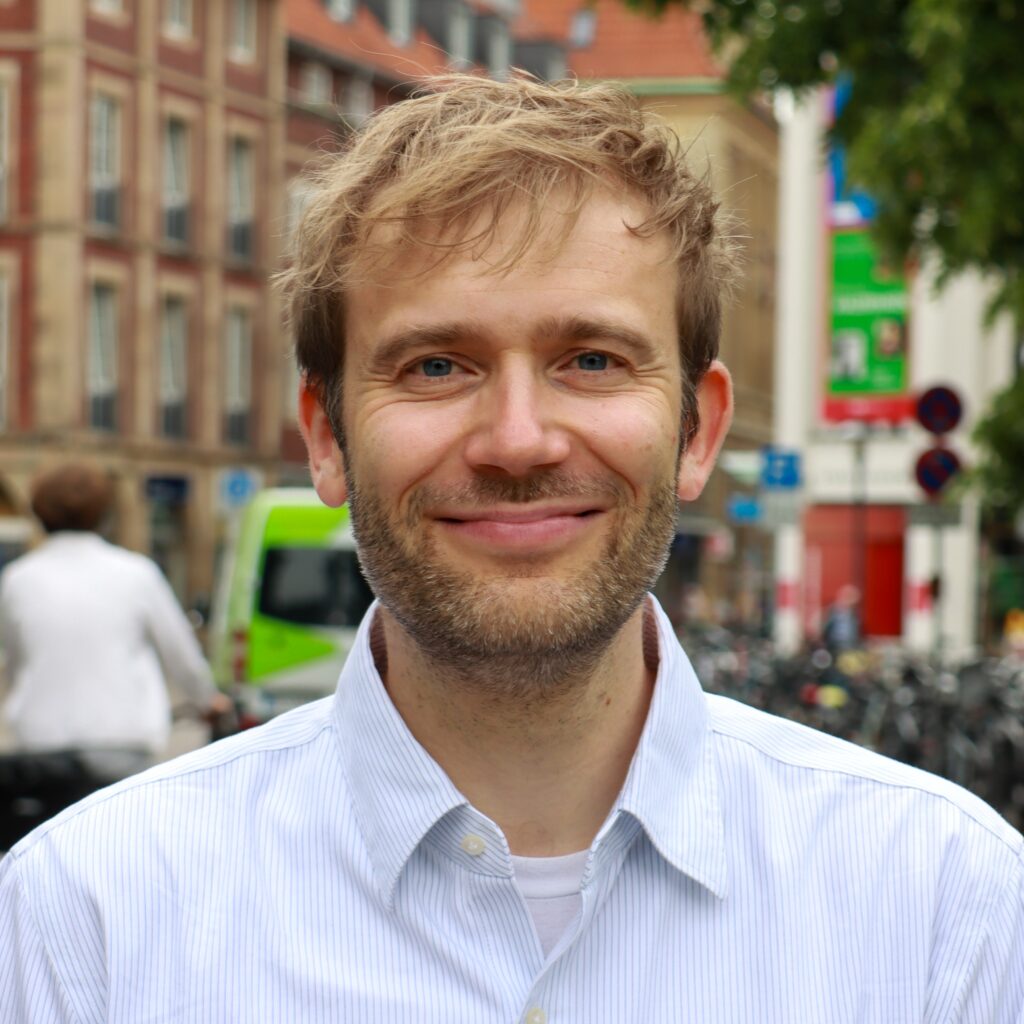
Dr Dominik Krell studies Islamic law in Saudi Arabia and its global influence. He has been a fellow at the Centre for Socio Legal Studies at the University of Oxford and at the Max Planck Institute for Comparative and International Private Law. In 2026/2027, he is a fellow at the Käte Hamburger Kolleg.
What are you researching during your fellowship?
My research addresses the role of Saudi Arabia in the contemporary Muslim world. I explore how ideas about Islamic law originating in Saudi Arabia affect Islamic courts outside the Arab world. I am looking at two cases in particular: The Gambia in West Africa and Sri Lanka in South Asia. My focus is on everyday practice at Islamic courts in both countries and how it is changing under increasing Saudi influence.
What significance do these shifts have in the context of the globalisation of law?
Some of the shifts are fundamental. They affect not only the rules themselves but also how courts handle evidence, the languages they communicate in, and how judges think about the law and legal change more broadly. Saudi influence has often been portrayed as a simple matter of copying Saudi Islam. What I am trying to do is complicate this picture by tracing legal ideas and practices from their development in Saudi Arabia to actual decisions in courts that are thousands of kilometres away. As in other areas of life, globalisation does not mean the complete erasure of local practices; rather, different local contexts affect how legal ideas are received.
You have just organised an interdisciplinary workshop at the Kolleg with the concise title ‘How Law Travels’. What was it about?
Comparative lawyers in particular, but also many anthropologists, tend to see law as the product of groups rather than of individuals. The workshop tried to put the individual at the centre of legal developments, focusing in particular on how individuals carry law with them to new contexts. The idea was to bring together scholars working on a variety of contexts and traditions to look for common phenomena and trends and to enter into a conversation that transcends the more specialised debates we usually engage in.

Why is it important to take a closer look at the role of individuals?
Because they play a central role in the way law has developed and continues to develop. Several contributions showed that it was individuals who brought about significant changes, from introducing new legal methodology and establishing new teachings to developing new legal codes. How these individuals carried ideas with them, however, is often difficult to trace. The workshop showed that two of the main problems with doing research on how law travels with individuals are language barriers and regional specialisation. The individuals we are looking at have moved between different regions, so we usually have to learn several languages and to understand the law in at least two different settings.
Was there any particularly surprising insight that you took away from the discussions?
What surprised me most was the variety of methods and ways of approaching the law that travel with individuals. All papers highlighted that legal change is not primarily about isolated rules being copied. This holds across traditions, as shown by examples as diverse as the Tibetan legal tradition, Islamic law, and medieval German law. I hope the workshop was just the first step towards a renewed interest in the role of the individual in legal developments.
Interview by Lennart Pieper
Cite as:
Dominik Krell/Lennart Pieper: “It was individuals who brought about significant changes in law”. Interview, EViR Blog, 20.11.2026, https://www.evir.uni-muenster.blog/en/interviewkrell/.
Licence:
This work is licensed under a Creative Commons Attribution-ShareAlike 4.0 International License.



Leave a Reply